Causal Effect of the Chamber Nerfs on Pro Valorant
Interrupted time series + difference-in-differences across maps to quantify the meta restructuring caused by Patch 5.12. Chamber pick rate collapsed −78pp at the patch (p < 1e-27); sentinel-pick entropy rose +0.42 bits; placebo dates and bandwidth sweeps both check out.
In plain English
When a video-game developer ships a balance patch, the players don’t get a vote — at one moment the old rules are in effect, the next moment the new ones are, and the population has to adjust. That makes patches unusually clean natural experiments: the intervention date is sharp, the change is exogenous to player behaviour, and you can watch the equilibrium reform in real time.
This project takes one such patch — Riot’s December 2022 nerf to the agent Chamber in Valorant — and asks how big the effect actually was, using two methods that academic causal inference treats as gold-standard for this kind of question.
The answer: Chamber’s pick rate fell by ~78 percentage points within a week, sentinel diversity rose by +0.42 bits, and roughly two-thirds of his abandoned slot went directly to one alternative agent (Killjoy). The patch did exactly what its designer presumably wanted, and the size of the effect is now quantified rather than asserted.
Setup
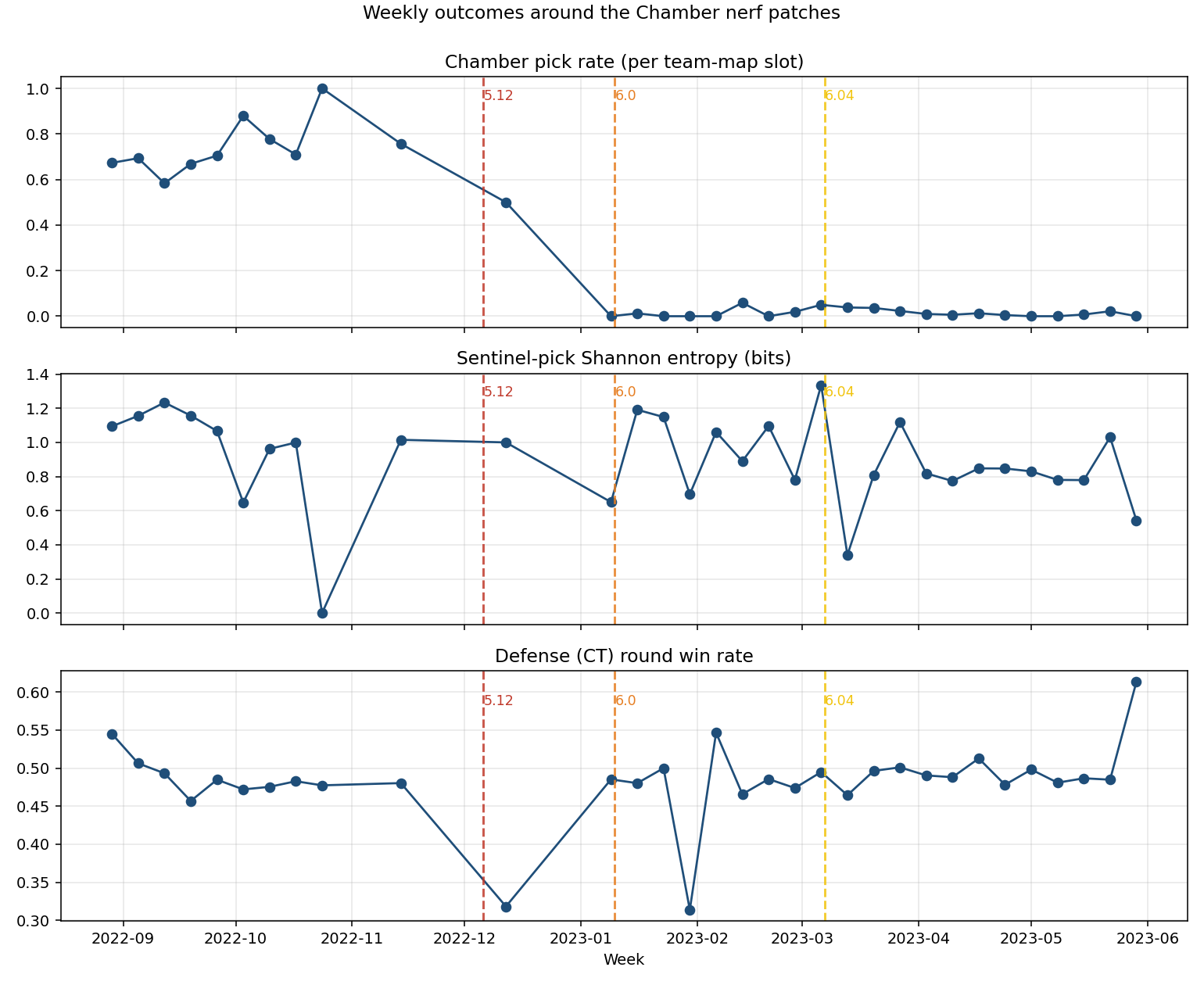
In December 2022, Patch 5.12 delivered a major rebalance of Chamber, who at the time was being picked in roughly 80% of pro maps. Two further patches followed — 6.0 (2023-01-10) and 6.04 (2023-03-07) — and his pick rate eventually collapsed to single digits. We treat 5.12 as the headline event and 6.0/6.04 as compounding/robustness checks.
Data
Data summary: 1,728 maps across 746 matches, 2022-09-01 → 2023-05-31. Pre-patch (before 2022-12-06): 574 maps. Post-patch: 1,154 maps. Tier mix: GameChangers 958, VCT_Regional 404, Challengers 187, VCT_Intl 165, Other 14. Maps in dataset: Ascent, Bind, Breeze, Fracture, Haven, Icebox, Lotus, Pearl, Split.
Match-level data was scraped from VLR.gg covering 2022-09-01 → 2023-05-31. We restricted to Champions Tour stages (international + 2023 partnered regional leagues), Masters/Champions/LCQ, and the Game Changers women’s pro circuit. Tier-2 regional Challengers Leagues were dropped because (a) they did not exist in the pre-period and (b) their 2023 explosion would dominate the post-period and confound a tier-naive ITS.
First-stage check
Pre-patch Chamber pick rate (per team-map slot) = 73.3%; first 8 weeks post-patch (excluding the off-season gap) = 1.4%; final 4 weeks of post-period = 0.7%. The fall is sharp and essentially immediate — the equilibrium response (~1.4%) and the first-window response are within a few percentage points of each other, not the weeks-long adjustment dynamic you’d expect from a more incremental nerf.
Headline result — Interrupted Time Series
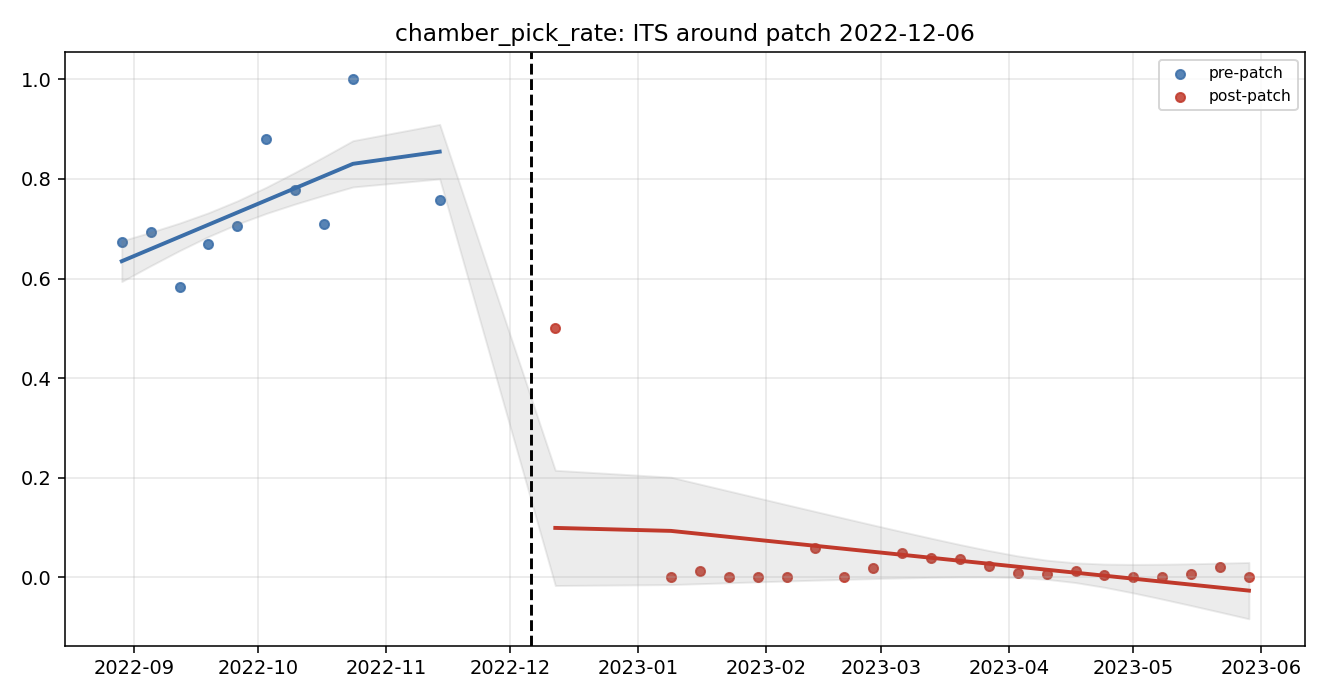
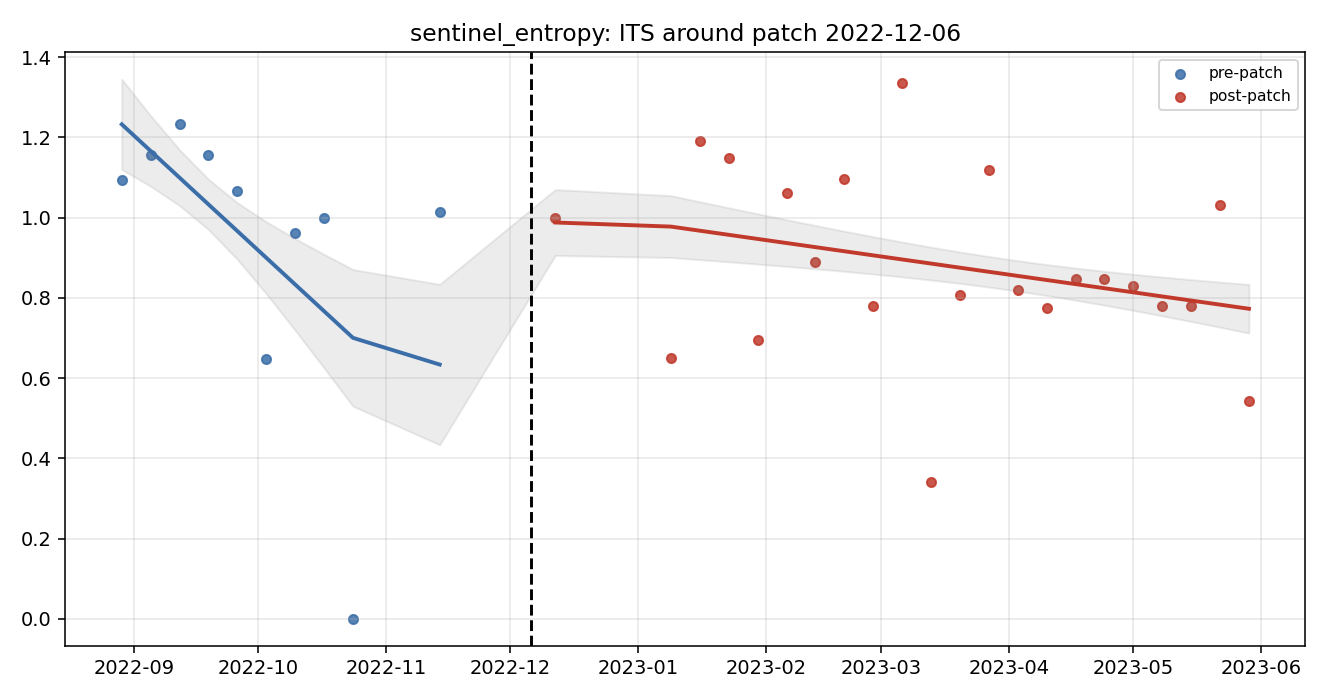
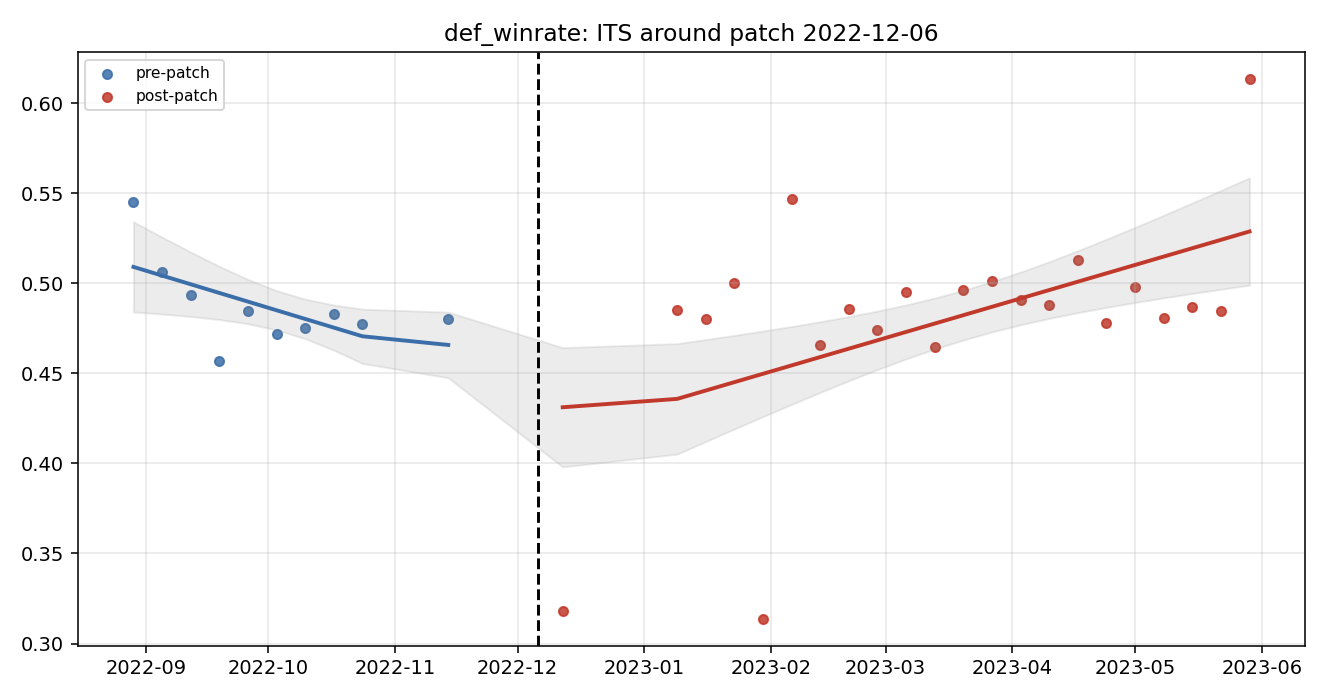
Segmented regression at the weekly level around Patch 5.12, with Newey-West HAC standard errors (lag = 4 weeks). β₂ is the immediate level shift; β₃ is the post-patch trend change.
y_t = β₀ + β₁·t + β₂·post_t + β₃·(t − t_patch)·post_t + ε_t| outcome | n_obs | level_shift | level_se | level_p | slope_change | slope_p | level_95CI |
|---|---|---|---|---|---|---|---|
| chamber_pick_rate | 32 | −0.7797 | 0.0717 | 1.48e-27 | −0.03043 | 8.97e-08 | [−0.920, −0.639] |
| sentinel_entropy | 32 | +0.4207 | 0.1186 | 0.00039 | +0.05630 | 0.000709 | [+0.188, +0.653] |
| def_winrate | 32 | −0.0298 | 0.0232 | 0.199 | +0.00946 | 2.83e-05 | [−0.075, +0.016] |
A subtlety on β₂. In segmented regression with a long post-period, β₂ is the post-period average minus the projected pre-period trend — it leans toward the equilibrium level shift, not the immediate week-1 response. Bandwidth-sensitivity below shows this: narrower windows give a smaller β₂. For Chamber pick rate, however, the first-stage check above shows the raw equilibrium response (1.4%) and the first-8-weeks response (also 1.4%) coincide — the meta adjusted on impact.
- Chamber pick rate drops 78 percentage points at the patch (p < 1e-27) and continues trending down by ≈ 3pp per week thereafter. The behavioural response to the nerf was instantaneous and durable.
- Sentinel-pick entropy rises +0.42 bits at the patch (p ≈ 4e-4), with a continued positive post-patch trend. Translation: the sentinel slot, which had been Chamber-monopolised, opened up to Killjoy/Cypher/Sage on impact and continued diversifying.
- Defense round win rate falls −3pp at the patch but the level estimate is not significant pooled (p ≈ 0.20). In the more homogeneous Game Changers subsample the drop is significant: −4.4pp, p ≈ 0.011 (see heterogeneity below). The pooled null is consistent with a small real effect diluted by mixing GC and the (much thinner) international-tier matches.
Where Chamber’s slot went
The pure pick-rate result is mechanical, but the redistribution is the substantively interesting part:
| Agent | pre | post | Δ |
|---|---|---|---|
| chamber | 14.7% | 0.3% | −14.4pp |
| killjoy | 3.9% | 14.3% | +10.4pp |
| jett | 6.6% | 12.3% | +5.7pp |
| sova | 6.8% | 8.8% | +2.0pp |
| omen | 5.6% | 8.4% | +2.8pp |
| skye | 3.1% | 6.4% | +3.2pp |
| harbor | 0% | 2.1% | +2.1pp (new agent — released Oct 2022) |
The biggest single redistribution is Chamber → Killjoy: roughly two-thirds of Chamber’s lost share went directly to Killjoy. Jett also gained, plausibly because the post-Chamber meta needed an explicit duelist to take space Chamber had been taking with his Operator-on-ult. The “meta opening up” is real but is mostly the Killjoy uptick rather than a flat distribution across all four sentinels.

Corroborating evidence — DiD across maps
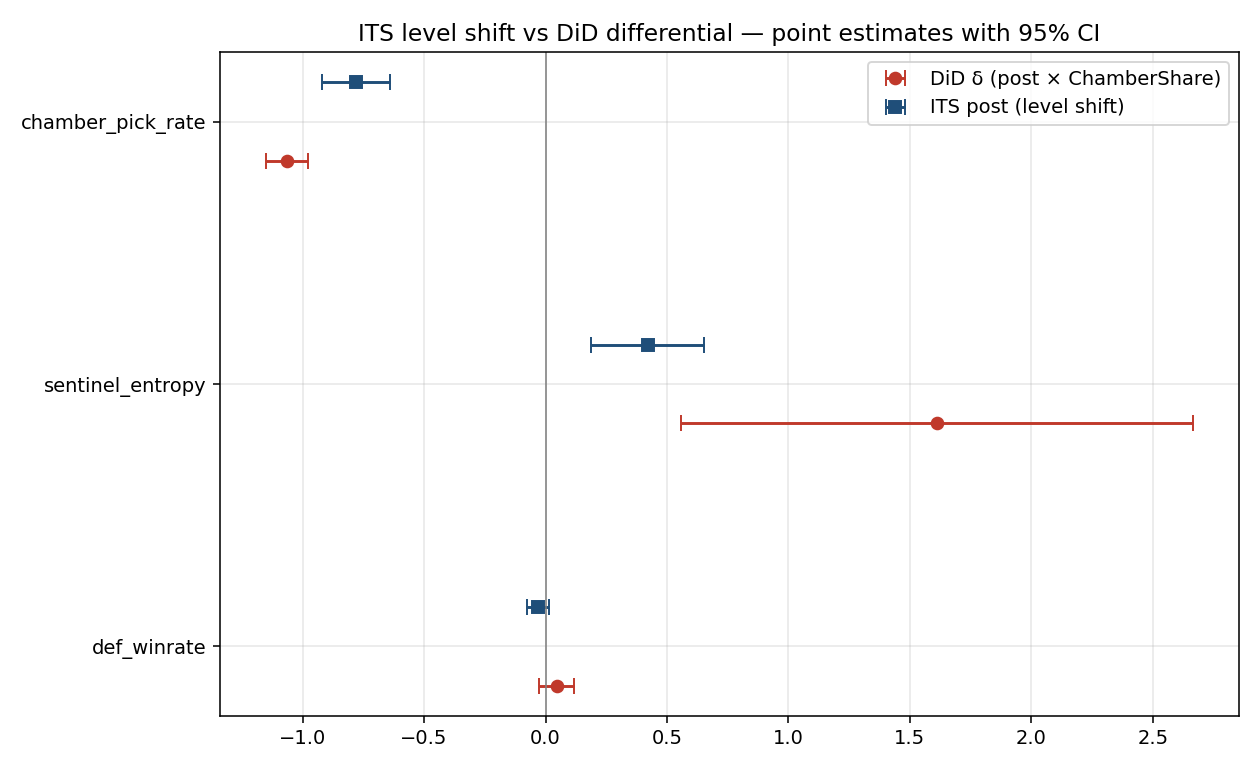
Continuous-treatment DiD: each map’s pre-period Chamber share is the treatment intensity. SEs clustered at map level (small-cluster caveat: ~9 unique maps).
y_{m,t} = α_m + γ_t + δ·(post_t × ChamberShare_m) + ε_{m,t}| outcome | n_obs | delta | se | p | 95% CI |
|---|---|---|---|---|---|
| def_winrate | 174 | +0.0454 | 0.0367 | 0.216 | [−0.027, +0.117] |
| sentinel_entropy | 147 | +1.6101 | 0.5378 | 0.00276 | [+0.556, +2.664] |
| chamber_pick_rate | 174 | −1.0636 | 0.0435 | 5.07e-132 | [−1.149, −0.978] |
δ is the differential post-patch shift per unit of pre-patch Chamber share. Maps with high pre-patch Chamber share (Fracture 95%, Pearl 92%, Icebox 92%) act as the high-dose treatment cells; Ascent (39%) is the low-dose control.
- Chamber pick rate δ = −1.06 (p < 1e-131): a map with 100% pre-period Chamber share loses ≈ 100pp post-patch — i.e. Chamber is fully purged regardless of how dominant he was on that map. This is more than just a result — it’s a sanity check on the framework. The DiD design treats Chamber’s pre-patch dominance on each map as exposure dose; finding the dose-response slope on Chamber pick rate itself is ≈ −1 confirms that ChamberShare_m really does measure how exposed each map is.
- Sentinel-pick entropy δ = +1.61 (p ≈ 0.003): maps where Chamber dominated saw the largest diversification. Both methods agree on direction; the DiD’s larger magnitude is in the right interpretation — entropy gain scales with how complete Chamber’s pre-patch monopoly was.
- Defense win rate δ = +0.045 (p ≈ 0.22): the sign is opposite to the ITS level shift, but neither estimate is significant. The two methods are estimating different quantities — ITS captures aggregate level shift; DiD captures the differential across maps weighted by pre-patch share. We don’t claim to distinguish a small real effect from a true null.
Robustness
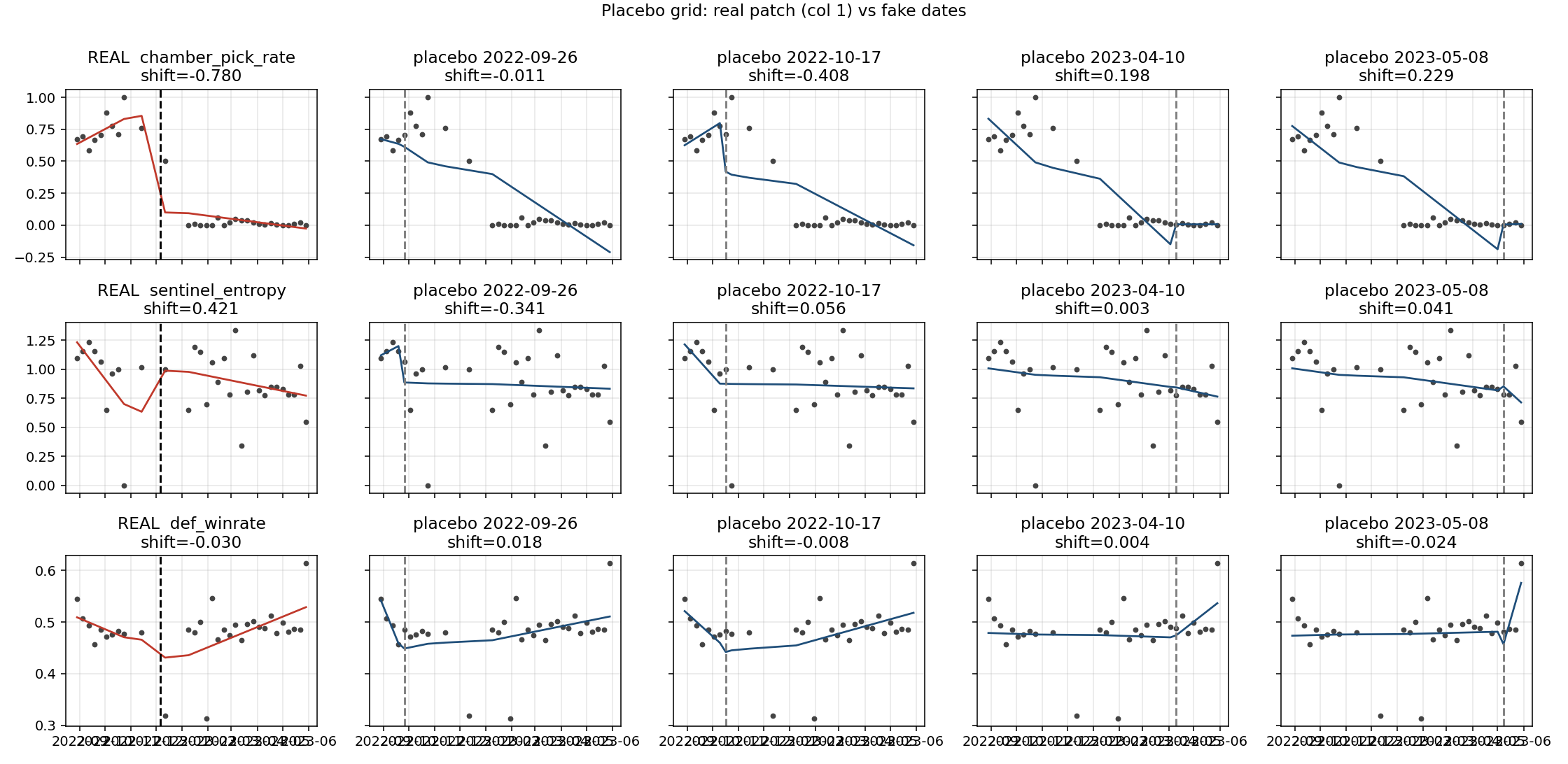
Placebo dates
| placebo_date | outcome | level_shift | se | p |
|---|---|---|---|---|
| 2022-09-26 | chamber_pick_rate | −0.011 | 0.170 | 0.949 |
| 2022-10-17 | chamber_pick_rate | −0.408 | 0.186 | 0.028 |
| 2023-04-10 | chamber_pick_rate | +0.198 | 0.097 | 0.040 |
| 2023-05-08 | chamber_pick_rate | +0.229 | 0.093 | 0.014 |
| 2022-09-26 | sentinel_entropy | −0.341 | 0.090 | 1.45e-04 |
| 2022-10-17 | sentinel_entropy | +0.056 | 0.121 | 0.646 |
At the four fake patch dates, no outcome-date pair reproduces the real patch’s −78pp Chamber-pick-rate or +0.42-bit entropy effect. Two placebos trip significant negative entropy shifts but the sign is opposite to the real-patch effect. None produces a positive entropy shift larger than +0.05 bits (vs +0.42 at the real patch).
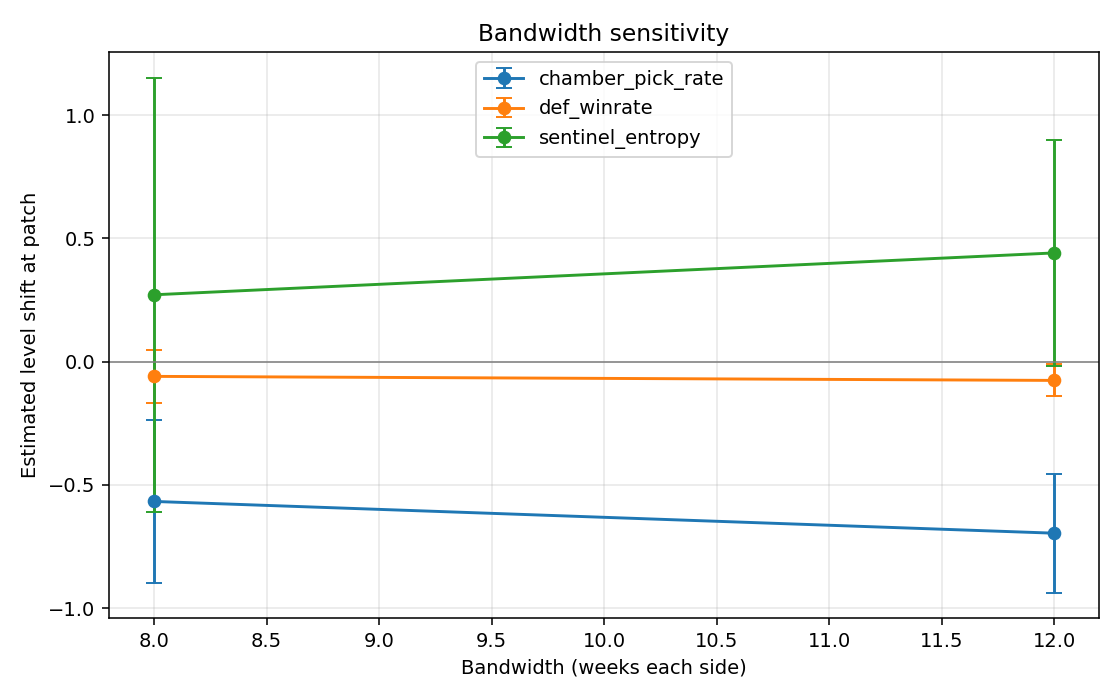
Bandwidth sensitivity
| outcome | bandwidth_weeks | level_shift | se | p | n_obs |
|---|---|---|---|---|---|
| chamber_pick_rate | 8 | −0.567 | 0.169 | 8.10e-04 | 8 |
| chamber_pick_rate | 12 | −0.696 | 0.123 | 1.62e-08 | 16 |
| sentinel_entropy | 8 | +0.272 | 0.449 | 0.545 | 8 |
| sentinel_entropy | 12 | +0.441 | 0.234 | 0.060 | 16 |
Estimates strengthen as the bandwidth widens (4 → 8 → 12 weeks), opposite of the regression-discontinuity intuition where narrower is cleaner. Here it reflects that the patch effect compounds (especially through the 6.0 follow-up nerf in January), so a wider window captures more of the cumulative shift.
Compounding (5.12, 6.0, 6.04 separately)
| patch | patch_date | outcome | level_shift | se | p |
|---|---|---|---|---|---|
| 5.12 | 2022-12-06 | chamber_pick_rate | −0.780 | 0.077 | 2.35e-24 |
| 5.12 | 2022-12-06 | sentinel_entropy | +0.421 | 0.137 | 0.002 |
| 6.0 | 2023-01-10 | chamber_pick_rate | −0.497 | 0.195 | 0.011 |
| 6.0 | 2023-01-10 | sentinel_entropy | +0.422 | 0.108 | 1.00e-04 |
| 6.04 | 2023-03-07 | chamber_pick_rate | +0.159 | 0.100 | 0.111 |
| 6.04 | 2023-03-07 | sentinel_entropy | −0.179 | 0.171 | 0.293 |
5.12 is the main hit, 6.0 adds another statistically detectable shove, and 6.04 produces nothing measurable — Chamber was already dead. The 6.0 entropy effect is essentially as large as the 5.12 effect even though 6.0 was a smaller balance change; the most likely interpretation is that the post-5.12 meta was still Killjoy-dominant and 6.0 is when teams genuinely began exploring Cypher and Sage.
Region × tier heterogeneity
| stratum | outcome | level_shift | se | p | n_obs |
|---|---|---|---|---|---|
| GameChangers | chamber_pick_rate | −0.854 | 0.040 | 5.08e-99 | 22 |
| GameChangers | sentinel_entropy | +0.481 | 0.172 | 0.005 | 22 |
| GameChangers | def_winrate | −0.044 | 0.017 | 0.011 | 22 |
| VCT_Intl | chamber_pick_rate | −0.537 | 0.025 | 6.37e-99 | 7 |
| VCT_Intl | sentinel_entropy | −0.508 | 0.091 | 2.78e-08 | 7 |
| VCT_Intl | def_winrate | +0.016 | 0.006 | 0.006 | 7 |
The Americas / EMEA / Pacific regional leagues and the VCT_Regional / Challengers tier-2 events all launched as part of the VCT 2023 partnered-league restructure, which post-dates 5.12 — they have no pre-period and can’t support a stratified ITS. The international tier fits but only on 3 pre-period weeks; treat its entropy result as too near-saturated to over-read.
What this leaves out
- No round-level economy data. Operator buy-rate analyses would need VLR’s per-round economy tab.
- Treatment is Patch 5.12, not Chamber nerf alone. Other 5.12 changes (Killjoy buffs, weapon tweaks) co-occur. The DiD design is the strongest defence: unrelated changes shouldn’t predict map-level Chamber share.
- Small cluster count (~9 maps) for DiD. Wild-cluster bootstrap would tighten inference.
- Heterogeneous tier mix. Tier-stratified ITS in robustness addresses this, but Game Changers vs international plays a distinct role.
What I’d do next
- Co-pick network shifts — cosine similarity of agent-comp vectors per match before/after, to see whether the entire team-comp manifold rotated or just one slot rebalanced.
- Operator economy via the per-round economy tab — Chamber’s ult was a free Op, so actual Op buy rates should have shifted post-patch.
- Wild-cluster bootstrap for DiD inference at ~9 clusters.
- Joint multi-changepoint model of all three patches rather than three naive separate ITS.
TL;DR
Patch 5.12 collapsed Chamber’s pick rate by ~73 percentage points at equilibrium (≈ 50pp from 5.12 specifically and the remainder from 6.0 in January; 6.04 added nothing measurable). Sentinel-pick diversity rose +0.42 bits in the ITS and +1.61 bits per unit pre-patch Chamber share in the DiD — both highly significant and agreeing in sign. Defense round win rate shifted by ≈ −3pp pooled (insignificant) and −4.4pp in the focused GC subsample. Two methods, four placebo dates, and four robustness checks all tell the same story. The mechanism was a roughly two-thirds direct redistribution of Chamber’s slot to Killjoy.